Book Review
Wabash 1791

Wabash 1791: St Clair's DefeatBack in November, I stopped at Fort Recovery specifically to pick up a copy of Wabash 1791: St Clair’s Defeat and to hear the author speak. There’s a blog entry about that visit here. John Winkler began his talk that day by briefly describing the circumstances that preceded the battle then, while frequently pointing to a projected map of the battlefield, he stepped though November 4, 1791, by locating key figures and events in space and time. He spoke from memory and it was obvious he knew his stuff. The knowledge he demonstrated in that talk fills the pages of Wabash 1791. In fact, the book could be considered a hard copy version of that talk — with a few thousand fold increase in detail.
Winkler begins the book, as he did that presentation, by talking of things that led to the battle only here he is not quite so brief. The world at the end of the eighteenth century can be pretty tough for modern day readers to imagine. When the Battle of the Wabash took place, the United States constitution was barely three years old and our very first president was only half way through his first term. The Ohio River was the nation’s border. England was still very much a military presence in North America and would officially be at war with the US in another twenty years. In 1791, there were plenty who thought England just might be picking up the pieces of her old colonies once the US collapsed.
After Winkler describes what he calls “The Strategic Situation”, he moves on to describe the opposing forces. The leaders of the two armies were certainly different but all were among the best of their time. St Clair, Butler, and Darke are just a few of the proven officers leading the Americans. On the Indian side, an equally qualified group of leaders surrounded chiefs such as Little Turtle, Blue Jacket, and Buckongahelas and the hated renegade Simon Girty. Also present were some out-of-uniform British officers. At the level of individual combatants, however, different meant unequal.

Recruiting had not gone well and continuing supply problems made it worse. Delays in supplies resulted in expiring enlistments and lack of supplies hampered training. In a sad “For want of a nail the shoe was lost…” style example, a shortage of paper led to a shortage of musket cartridges for training and target practice. As hard as it is to believe, some new recruits marched out of Camp Washington without ever having fired their guns. By contrast, fighting was part of every Indian’s life. Winkler quotes an officer who wrote, “…war is their principal study, in this they have arrived at considerable perfection.”

I hesitate to use the word “scholarly” but it really is appropriate for portions of the book. In particular, some of this early background information reads like a text-book and can be rather dry going. But there’s lots of good information being conveyed and the payoff occurs when the battle begins. Winkler can report the action without the need to repeatedly explain why one side did this and the other that. And report the action he does and it is brutal. Though the two armies were roughly equal in size, approximately 1700 soldiers and militia versus 1400 Indians, most of the experience and all of the surprise was with the Indians.

Two types of illustrations augment Winkler’s battle descriptions. Color coded diagrams show three stages of the battle and artist Peter Dennis has produced three “snapshots” to help visualize the scene. The one used for the cover shows Captain Henry Carberry shouting at the demoralized soldiers to charge the encircling Indians simply in order to escape. Numerous photographs and drawings illustrate other sections of the book.

More US soldiers died that day than in any battle prior to the Civil War. This battle was the greatest victory American Indians ever achieved over US forces. The loss nearly eliminated all United States military capabilities and had the potential for destroying the young nation. In fact, a proposed investigation into supply chain corruption was abandoned to avoid that very risk. With the passage of time, this clearly significant battle has been largely forgotten by non-historians. How much success Winkler’s book has in reviving the memory is yet to be seen but it seems to contain all of the details needed for filling in the blanks.

Wabash 1791: St Clair’s Defeat, John F Winkler, Osprey Publishing, November 2011, paperback, 9.6 x 7.1 inches, 96 pages, ISBN 978-1849086769


I’ve seen other accounts of St Clair’s Defeat. Allen Eckert’s fairly short one in That Dark and Bloody River is a pretty easy read. Eckert writes in the style of a novel with the factual base of a text book. In my youth, as I was first learning of the battle that occurred just about fifteen miles from where I grew up, I formed the impression that St Clair was a bumbling idiot and was almost single handedly responsible for the disaster. As I learned more of the supply and equipment problems, my view softened. Eckert blames St Clair for not aborting the campaign in light of the huge recruiting and supply issues but little else. Winkler hardly blames him even for that. That could just be the result of Winkler’s even handed reporting where he presents facts and holds back opinions.

As I read Wabash 1791 with the internet at my fingertips, I learned of a 1896 Harper’s Magazine article on the subject written by Theodore Roosevelt. This was just over a hundred years after the battle. A slightly edited version was included in volume 5 of Roosevelt’s Winning of the West published in 1905. Roosevelt doesn’t think much of St Clair and describes him as possessing “none of the qualities of leadership save courage.” Perhaps he was a bumbling idiot after all. ‘Tis a puzzlement.


Thumbnails of scans of the Roosevelt article appear in the archives section of the Harper’s website. Accessing full sized readable copies requires a subscription. However, there is another section of the website, apparently sponsored by Balvenie scotch whiskey, which contains articles written by folks such as Lewis Carroll, Mark Twain, and… Theodore Roosevelt. Maybe they’re all Balvenie drinkers. The 1896 Roosevelt article is available there. A far from full bottle of The Balvenie sits in my liquor cabinet and I poured myself a wee dram to drink a toast in thanks for the article. You can read the article here but you’ll have to supply your own whiskey.

Dickens of a Christmas

Ohio History Center ControversyI missed it. I missed an exhibit I really wanted to see. From April through November, the Ohio Historical Center had a display entitled Controversy: Pieces You Don’t Normally See. Of the five items it contained, the retired electric chair seemed to be the main attraction with a KKK outfit, a thumb mitt, an adult crib, and a nineteenth century condom rounding out the bill. I’m sure I drove by the building more than once while the exhibit was in place but, as we often do, I assumed there would always be another chance. It wasn’t until I visited the Ohio Historical Society’s website to sign up for Dickens of a Christmas that I realized that I’d blown it.

Dickens of a Christmas is an annual festival sort of thing that takes place in the recreated nineteenth century village adjacent to the Historical Center. I registered to attend the first night of Dickens of a Christmas and, even though there was no electric chair or condom to be seen, headed to Columbus in time to visit the Historical Center in the afternoon. That’s how I got the picture of the entrance to the recently closed Controversy exhibit.

The American Soldier Photographic TributeOhio Battle FlagsIn addition to the many worthwhile permanent exhibits, the Center currently has a captivating temporary exhibit called The American Soldier: A Photographic Tribute From The Civil War To Iraq and several of the 434 Civil War battle flags in the museum’s possession are on display. Plus, although it’s a poor substitute for an adult crib from an insane asylum, there was, once upon a time, at least a little controversy associated with the two headed calf.

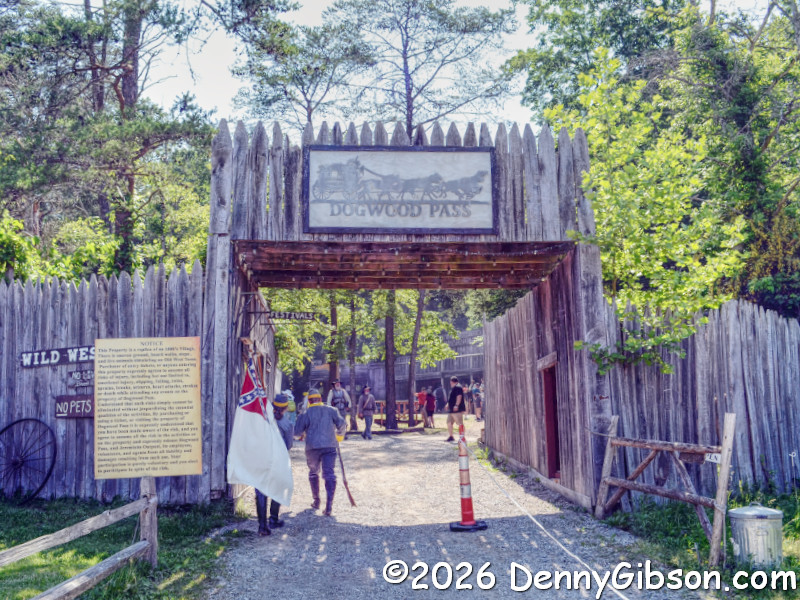
Saint Nicholas at Dickens of a ChristmasThe Ohio Historical Center is certainly a cool place to spend an afternoon but the title of this entry is “Dickens of a Christmas”. My evening at Ohio Village is covered in a separate Oddment page here. It is only the second Oddment page added since the start of this blog. While there is no precise definition of what qualifies one subject for an oddment page and another for a blog entry, it seems likely that I’ve completely covered a subject in a blog entry that might have appeared as an Oddment in pre-blog days and it is all but certain that some of the existing Oddment pages would have instead been blog entries had the blog existed at the time they were created. I believe one of the things that helps decide Oddment or blog is number of pictures. I haven’t posted a huge amount of pictures from Dickens of a Christmas but there are more, sixteen, than I feel comfortable with in a blog entry. Look them over at the Dickens of a Christmas Oddment page.


I know some who see this will have heard of Kickstarter but I’m guessing not all. It’s a method for funding projects with large numbers of small contributions. Learn more about it at the Kickstarter website. Kickstarter depends a lot on word of mouth. Friends tell friends, usually in an indirect Facebook/Twitter/newsletter sort of way, about projects they like and that, in case you haven’t guessed, is what I’m doing here. I’ve contributed to a couple of projects that I liked and blown off a couple more that didn’t quite click with me. I recently learned of a documentary project that I like and, since you’re reading about it here, there’s a chance you will too.

I heard of the project from Dirk Hamilton. It isn’t Dirk’s project but he is in it. I was inclined to give it a couple of bucks ’cause I like the general subject and, of course, I like Dirk but I was hooked for sure when I read the “Part music documentary and part road trip movie…” line. The documentary is called Folk. Check out its Kickstarter page here.

Electric Horsemen & Horsewomen

Greenville Hometown Holiday Horse ParadeThe practice of using lawn chairs to stake out prime territory at various events has long both amused and irritated me. It flourishes in smaller communities where honesty abounds and scoundrels tempted to displace or abscond with the portable furniture are simply not tolerated. I’d guess that any chair plopped down ten hours ahead of a concert in NYC’s Central Park would be long gone before showtime but I don’t really know that. Last night, Greenville, Ohio, held its eighth Hometown Holiday Horse Parade. The picture at right was taken about 5:30 but some of those chairs were there when I drove through town around 10:00 AM.

Greenville Hometown Holiday Horse ParadeThis is a big event and the crowd grows to four or more deep in a matter of minutes. This picture shows the scene about five minutes before parade start — about an hour and a half after the first one. It’s not logical that this somehow irritates me slightly. The way I operate, I’m going to be behind those four or five rows regardless of when or by whom they were filled. I am not personally affected by the fact that the front row is filled by people whose cousin dropped off a dozen chairs on his way to the turkey shoot but it doesn’t seem quite right. You have to stand for hours on Times Square or Gobbler’s Knob if you want to see the crystal ball or Punxsutawney Phil and that, in my view, is as it should be.

Greenville Hometown Holiday Horse ParadeGreenville Hometown Holiday Horse ParadeI believe this is the third or possibly fourth time I’ve attended the parade. I’ve taken pictures each time but I still don’t know how to do it. I have virtually no usable pictures of individual participants. This pair of photos looks north on Broadway shortly before the parade’s start and end. Staging for the parade is just to the right of these pictures and the horses enter Broadway more or less in front of where I’m standing and continue north. After rounding the traffic circle at Main Street, they retrace their path back along Broadway so those folks in chairs get to see them coming and going. The right hand picture shows the last few entries nearing the end of the route on their return.

Greenville Hometown Holiday Horse ParadeThis year’s parade reportedly had well over sixty entries. Some of those entries were groups of riders on horseback but it hasn’t always been so. For at least one year, horseback riders were banned because, as I understand it, some of the organizers felt that the parade was conceived around lighted wagons and carriages and it should stay that way. I have no opinion and just try to enjoy the lights and the horses whether they’re hitched to a wagon or not.

The last picture is obviously out of sequence and I’m including it mostly because I just like it. There had been some light rain in the afternoon and some predictions showed the chances increasing toward evening. That was definitely not what happened and the picture shows the clouds separating a bit as the sun goes down. This is the circle that marks the northern reach of the parade and, like the street itself, it is surrounded by thick walls of spectators as the horses pass by. Here‘s another picture from last night that has even less to do with the parade but which I may like even more.

Greenville Hometown Holiday Horse Parade


I would like to dedicate my mild rant against “chair claims” to America’s most congenial curmudgeon, Andy Rooney, who died two weeks ago. I don’t know that Andy cared one way or the other about modern concert and parade “sooners” but I do know that, if he did, he would have expressed his feelings a whole lot better than I did.


This morning I headed slightly north to Mason, Ohio, for breakfast. The Mason Grill is a great family owned business that always satisfies in terms of food, friendliness, service, and value. I walked in thinking mushroom omelet but changed my mind as soon as I read the chalkboard specials. Goetta omelet? I’d never seen goetta on their menu before and the waitress confirmed that it was a new but permanent addition. This might be goetta’s northern most outpost to date. After last week’s goetta-scrapple-mush discussion, there was no chance of me not ordering it. Unfortunately, goetta does not photograph well while buried in an omelet but here‘s my great tasting breakfast anyway.