Dickens of a Christmas

Ohio History Center ControversyI missed it. I missed an exhibit I really wanted to see. From April through November, the Ohio Historical Center had a display entitled Controversy: Pieces You Don’t Normally See. Of the five items it contained, the retired electric chair seemed to be the main attraction with a KKK outfit, a thumb mitt, an adult crib, and a nineteenth century condom rounding out the bill. I’m sure I drove by the building more than once while the exhibit was in place but, as we often do, I assumed there would always be another chance. It wasn’t until I visited the Ohio Historical Society’s website to sign up for Dickens of a Christmas that I realized that I’d blown it.

Dickens of a Christmas is an annual festival sort of thing that takes place in the recreated nineteenth century village adjacent to the Historical Center. I registered to attend the first night of Dickens of a Christmas and, even though there was no electric chair or condom to be seen, headed to Columbus in time to visit the Historical Center in the afternoon. That’s how I got the picture of the entrance to the recently closed Controversy exhibit.

The American Soldier Photographic TributeOhio Battle FlagsIn addition to the many worthwhile permanent exhibits, the Center currently has a captivating temporary exhibit called The American Soldier: A Photographic Tribute From The Civil War To Iraq and several of the 434 Civil War battle flags in the museum’s possession are on display. Plus, although it’s a poor substitute for an adult crib from an insane asylum, there was, once upon a time, at least a little controversy associated with the two headed calf.

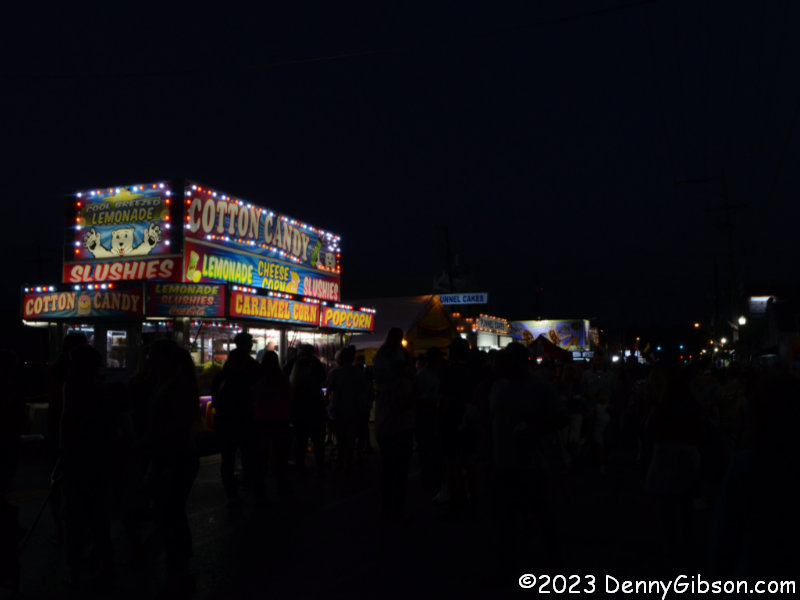
Saint Nicholas at Dickens of a ChristmasThe Ohio Historical Center is certainly a cool place to spend an afternoon but the title of this entry is “Dickens of a Christmas”. My evening at Ohio Village is covered in a separate Oddment page here. It is only the second Oddment page added since the start of this blog. While there is no precise definition of what qualifies one subject for an oddment page and another for a blog entry, it seems likely that I’ve completely covered a subject in a blog entry that might have appeared as an Oddment in pre-blog days and it is all but certain that some of the existing Oddment pages would have instead been blog entries had the blog existed at the time they were created. I believe one of the things that helps decide Oddment or blog is number of pictures. I haven’t posted a huge amount of pictures from Dickens of a Christmas but there are more, sixteen, than I feel comfortable with in a blog entry. Look them over at the Dickens of a Christmas Oddment page.


I know some who see this will have heard of Kickstarter but I’m guessing not all. It’s a method for funding projects with large numbers of small contributions. Learn more about it at the Kickstarter website. Kickstarter depends a lot on word of mouth. Friends tell friends, usually in an indirect Facebook/Twitter/newsletter sort of way, about projects they like and that, in case you haven’t guessed, is what I’m doing here. I’ve contributed to a couple of projects that I liked and blown off a couple more that didn’t quite click with me. I recently learned of a documentary project that I like and, since you’re reading about it here, there’s a chance you will too.

I heard of the project from Dirk Hamilton. It isn’t Dirk’s project but he is in it. I was inclined to give it a couple of bucks ’cause I like the general subject and, of course, I like Dirk but I was hooked for sure when I read the “Part music documentary and part road trip movie…” line. The documentary is called Folk. Check out its Kickstarter page here.

More Horses (and a bit on a madonna)

Last night I completed the trifecta of southwest Ohio horse parades. I just happened to be in Greenville on the occasion of their parade two weeks ago. I blogged about it here. Last week I was again in Greenville and came home through Springfield with a goal of getting some pictures of the recently relocated Madonna of the Trail statue. (More on that later.) I was surprised to see downtown Springfield blocked off and more surprised to learn that it was for the city’s first ever hose parade. I certainly had to stick around for that.

Springfield Horse ParadeCarriage rides were available before the parade and, yes, I took one. Neither the carriage rides nor the parade actually passed the Madonna. The picture at right shows one of the “public” carriages leaving the blocked off area in anticipation of the parade itself. The parade formed behind where I stood to take the picture and turned right to reach the parade route proper.

Springfield Horse ParadeSpringfield Horse ParadeAs mentioned, this was Springfield’s first year for a parade and there were just fourteen entries. All were “hitches”. In other words, there were no horseback riders. The portrayal of  the Christmas story in a setting where eighteenth and and nineteenth century covered wagons (albeit with pneumatic rubber tires) was the norm was simultaneously shocking and 100% fitting. I liked it. Future generations of Springfieldians may have a very unique take on the whole Christmas-pioneer-Madonna-covered-wagon thing.

Black Horse Tavern at the Golden LambSo, after attending Springfield’s first and Greenville’s eighth more or less by accident, I felt almost obligated to attend Lebanon’s twenty-third horse parade. It’s not only the oldest of the three but, with 122 entries, far and away the biggest. It’s also the only double header. There is a daylight version at 1:00 and an in-the-dark illuminated-carriage version at 7:00. Other commitments kept me away from Lebanon until something after 1:00 but I headed there anyway thinking I might catch the tail end of the matinee. I couldn’t even get close. I whiled away the afternoon on the far side of town then returned thinking it entirely possible that I would just pass through again and head home. But I found a parking spot about three blocks from the Golden Lamb. In the Lamb’s Black Horse Tavern, I ran into some friends I hadn’t seen in quite awhile and managed to while away another couple of hours until parade time was near.

Lebanon Horse ParadeLebanon Horse ParadeI’ve attended both light and dark versions of the Lebanon parade before but it’s been a long time. Both the parade and attendance have had time to grow and they certainly have. All of downtown Lebanon was pretty much shoulder to shoulder and withers to withers.

Lebanon Horse Parade ClydesdalesLebanon Horse Parade Fire EngineSeveral of the parade participants had been at Greenville and a few had been at Springfield but with more than eight times Springfied’s entries and nearly double Greenville’s, Lebanon obviously had some exclusives. Foremost among these were a nineteenth century fire engine and a team of Clydesdales. Both of these actually brought cheers from the crowd when they charged down the street.

Golden LambDuring the parade I managed to somehow walk to it’s origin and back. Some of it was pretty awkward but in the end I just stepped into the street and paced the parade. I recall my father once telling me that the secret to getting around a military base is to carry a clipboard and walk briskly. The same technique works with parades using a camera. The friends I had met in the bar told of past success in watching the parade from the balcony at the Golden Lamb. Even though that appeared to be a bit more challenging than in prior years, they were going to give it a try. As the parade wrapped up, I snapped this picture of the hotel’s balcony just in case they were up there. No, I later learned, they had been blocked from the balcony but found an empty third floor dining room where they and another couple watched the parade in relative privacy. The only intruder was a hotel employee who stopped by now and then to take drink orders.


Ohio Madonna of the TrailNow, about that Madonna. In 1928 and ’29, as the era of named auto trails came to an end, the Daughters of the American Revolution placed a Madonna of the Trail statue in each of the twelve states through which the National Old Trails Road passed. The one for Ohio was placed in Springfield. Two of the four sides on each statue’s base were inscribed with information specific to the statue and its placement. On Ohio’s Madonna these concerned the end of federally funded construction, which was quite close to the statue’s original placement, and George Rogers Clark victory at Peckuwe which was about three miles from the original placement as noted in the inscription. In the mid 1950s, highway construction caused the statue to be moved about a half mile east. The inscriptions were no longer as accurate as they had been but they weren’t off too much. A bigger problem with the move was that, once US-40 became four lanes wide, there was no convenient access to the statue. Reaching it involved either pulling over on the busy highway or parking in a safe spot and walking along the busy highway.

Ohio Madonna of the TrailIn September, the statue was again moved. This move was about two miles distance to a park in downtown Springfield. The setting makes the statue much more accessible while making the inscriptions much less accurate. Some consider this a net win; Others don’t. During the hour or so I hung around the statue last Saturday, I saw about twenty people take note of the statue in some way. There was a lot of foot traffic in the area Saturday and the majority seemed oblivious to both the new park and the relocated statue. Of those that noticed it, about half recognized it including one fellow who arrived with camera and tripod to photograph the old gal in her new home. Quite a few of those who had no idea what it was did read at least one panel. Several read them all. Whether or not any of them develop even the slightest interest in any aspect of the history that this Madonna of the Trail represents is anybody’s guess.

A newspaper article about the September 22 move is here. The Madonna can be seen thirteen days before the move here and here.

Water Cardboarding

1992 must have been a fertile time along the big river in southwest Ohio. As noted in last Sunday’s post, the annual Cincinnati Blues Festival was just held for the 19th time. Yesterday, the 19th International Cardboard Boat Regatta took place just a few miles up river from Cincinnati. I don’t know what triggered that little rash of event birthing at Ohio’s southern edge. Maybe Iron City Brewing up in Pittsburgh had a big spill or something. Or it might just be lucky coincidence that got these two wonderful events going in the same summer.

RoadsideAmerica at Cardboard Boat Museum, New Richmond, OHIt was definitely a coincidence that I stopped by New Richmond’s Cardboard Boat Museum last month on the day before RoadsideAmerica.com was to arrive for a photo shoot and interview. This is the world’s only cardboard boat museum and the driving force behind the annual regatta. Of course I eagerly returned the next day for a chance to see Doug Kirby & Ken Smith in action. I’d submitted a few photos to the site and exchanged some email with Doug but had never met either of these fellows. For me, it was kind of like meeting Tiger Woods would be for a golfer. The report produced from the visit is here.

Cardboard boats waiting for race, New Richmond, OH, 2011Cardboard boats with mechanical assist, New Richmond, OH, 2011Now that the name dropping is out of the way, I can move on to yesterday’s regatta. Even though I’ve heard of it for years and watched many after the fact reports on local news, this was only the second year I’ve attended. New Richmond is one of those river towns that, in recent years, I tend to end up in during semi-aimless weekend drives. I naturally started popping into the museum whenever I saw it open and last year actually knew of the race date in advance. I used the 2010 race as the starting point of my Blue Ridge Parkway drive. As I recall, there were about fifty boats last year. That record was shattered by this year’s fifty-five entrants. There are different heats for juveniles and adults and for single and multiple person crews. Boats with “mechanical assistance” make up their own distinct class.

Broken cardboard boat, New Richmond, OH, 2011By rule, the boats are constructed of nothing other than cardboard, tape, and paint. The paint is critical though there is nothing special about it. The same basic house paint that keeps water from soaking into your wooden siding keeps it from soaking into cardboard. Of course, should water somehow find its way in, the cardboard reacts even quicker than peeling wood siding. By using different crews, many boats run in more than one heat. Some run in less than one heat.

Cardboard Man finish, New Richmond, OH, 2011After all the various class competitions are finished, any surviving boat with any crew can compete in a wide open free-for-all with the winner taking home the prestigious Cardboard Cup. In previous years, the Cardboard Cup race was the last of the day but this year a new event was added. This double length race would seriously test the stamina of any individual with the nerve to try it. Rather than the single downstream pass of the 200 yard course that makes up every other event, this race required entrants to paddle the course in both directions. The picture shows Sam Richmond about to cross the start/finish line to become the first recipient of the Cardboard Man title.

The Cardboard Man title is clearly out of my reach. In fact, almost everyone in a boat expended a lot more energy than I’d ever consider. The lone exception was the fellow who played steel drums while his wife propelled their craft. Now that’s a gig I think I could handle.

Steel drum cardboard boat, New Richmond, OH, 2011

A Musical Weekend

If I had introduced this blog a week earlier, the Cincinnati and Lebanon blues festivals could have been the subjects of last Sunday’s post instead of the “Hi, I’m a blog” thing. The downside of doing it this week is that it’s not near as timely. The upside is I’ve had a week to figure out how to include pictures.

The Cincinnati festival is a two day affair that fills Friday and Saturday evenings starting around 5:00 PM. Lebanon’s event is Saturday only with a start time of 11:00 AM. Both end sometime just short of midnight. Why these two festivals — just thirty miles apart — are held on the same weekend each year is something of a mystery but don’t expect it to change any time soon. Cincinnati was there first. This year was Cincinnati’s 19th and Lebanon’s 13th. So it was Lebanon that caused the collision but they always seems to have all the crowd they can handle and little incentive to move the date. Lebanon’s festival is free. Cincinnati’s isn’t. I suspect Cincinnati’s Saturday crowd is lessened a bit by the freeby up the road but the Cincinnati event is locked into its slot in the venue’s full schedule and couldn’t change if it wanted to..

Some years I’ve gone to neither and some years I’ve gone to both. Other years I’ve gone to one or the other. This was a “both” year. Cincinnati certainly has the bigger festival. It is spread out not only over two days but over three stages. There is a local stage featuring runners up from the local Blues Challenge. The winners, who will represent the Cincinnati Blues Society at the International Blues Challenge in Memphis, open the main stage. After that, it’s filled by national and regional acts. The third stage is alway boogie woogie piano on Saturday and something else on Friday. Last year it was the music of New Orleans. A tribute to the Ludlow Garage, a venue that brought big time acts to Cincinnati in the ’60s & ’70, was held there the year before. This year it was rockabilly.

Moreland & Arbuckle, 2011 Cincinnati Blues Festival

In theory, acts get better and better as the day progresses and peak with the headliner. I frequently find, however, that my own ranking doesn’t quite match the program. That was definitely the case on the main stage Friday. I was most impressed by Moreland & Arbuckle who were third from the top — right after the local openers. I had heard they were a two piece band and was surprised to see the drummer. Then, when they started playing, I was convinced there was a fourth member and walked across the front of the stage looking for a bass player behind the speakers. Nope. Dustin Arbuckle sings and plays killer harmonica while Aaron Moreland plays bass, rhythm, and lead on a single fretboard. Aaron does play “normal” guitars but I liked him best on his custom made four string cigar box with the top string set up specifically for bass work. The program says otherwise but I believe that is Kendall Newby on drums. His talents are a match for the other two.
Teeny Tucker, 2011 Lebanon Blues FestivalOn Saturday, I went to Lebanon in time to catch the last four acts. Most of the artists here can be considered local but local includes Cincinnati, Dayton, and Columbus and many bands from all of those cities do a lot of traveling. The Blue Birds Big Band, last year’s Cincinnati Blues Challenge winners, would close out the night but the main draw for me was the lady in the picture, Teeny Tucker, who was on just ahead of them. I had seen Teeny do a few songs in a Columbus bar during a benefit and I was looking forward to seeing her in control of the stage and with her full group. That’s one powerful and soulful young lady.

I saw a lot more good musicians than the ones pictured here and I know there were plenty I missed. There was real top notch blues talent on the stages of Cincinnati and Lebanon last weekend. I can’t say a bad thing about any of them but, baby, you know what I like.
Moreland & Arbuckle, 2011 Cincinnati Blues Festival